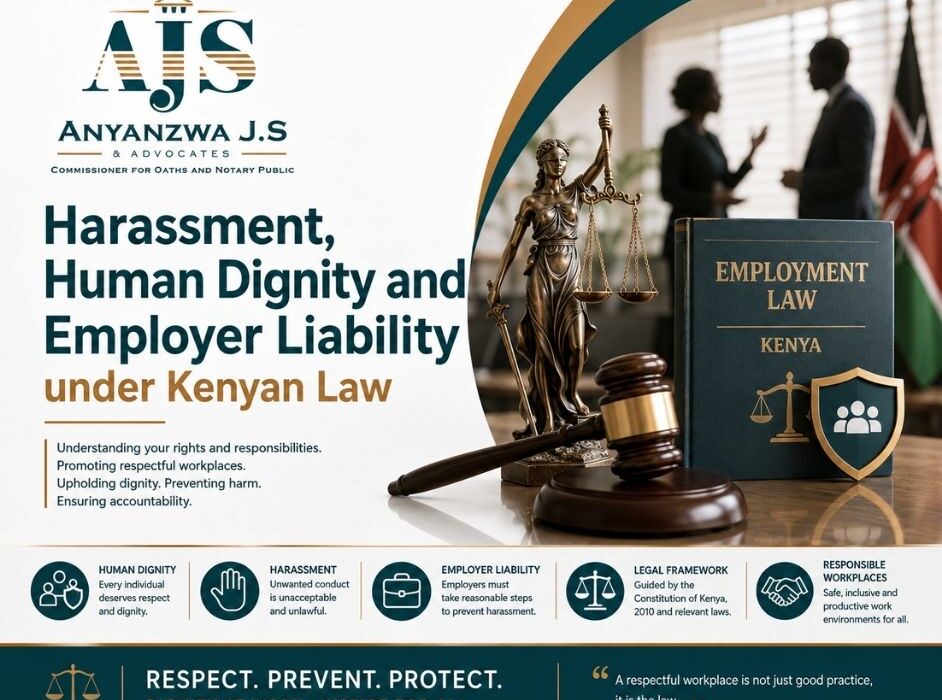
Harassment, Human Dignity and Employer Liability under Kenyan Law
Harassment in the workplace directly implicates the constitutional right to human dignity, among other rights, and imposes significant legal obligations on employers under Kenyan law. The legal framework recognises that dignity is inherent and inviolable, and that employment relationships must be conducted in a manner that respects this fundamental value.
1. Kenyan Legal Framework: Harassment as a Constitutional and Legal Wrong
In Kenya, harassment, whether verbal, psychological, or institutional is not treated as a narrow or purely private wrong. It is grounded in constitutional rights, reinforced by employment law, and increasingly informs the development of several key common-law and equitable remedies.
(a) Constitutional Foundations
Harassment constitutes an infringement of several core provisions of the Constitution of Kenya, 2010 including:
- Article 28 – Human Dignity
In Satrose Ayuma & 11 others v Registered Trustees of the Kenya Railways Staff Retirement Benefits Scheme & 3 others [2013] eKLR, the High Court affirmed that dignity is inherent and forms the foundation of all rights, requiring protection in institutional, employment and social settings.
The Employment and Labour Relations Court (ELRC) has severally held that harassment undermines the human dignity of the affected employees. In Viloko v Cuisine & another (Employment and Labour Relations Petition E017 of 2025) [2025] KEELRC 2688 (KLR) (2 October 2025) (Judgment), the ELRC held that degrading and humiliating language used by a Respondent (e.g., referring to the Petitioner as a malaya (prostitute) and explicit sexual threats) violated the Petitioner’s right to dignity under Article 28 of the Constitution. The hostile and demeaning conduct was found to undermine the Petitioner’s inherent dignity and left her in a psychologically harmful work environment.
- Article 27 – Equality and Freedom from Discrimination
Harassment that is degrading, exclusionary or abusive has been recognised as discriminatory conduct. In VMK v Catholic University of Eastern Africa [2013] eKLR, the Court held that employer conduct that is degrading, discriminatory, or oppressive violates the constitutional guarantee of fair labour practices under Article 41 of the Constitution, affirming Section 5(3) of the Employment Act and treating discrimination as a form of harassment. Although the dispute turned on unequal and unfair treatment, the Court’s reasoning confirms that harassment, broadly understood as conduct creating a hostile, demeaning, or insecure work environment, is incompatible with Article 41 and undermines employee dignity and psychological security as core elements of fair working conditions.
- Article 41 – Fair Labour Practices
The right to fair labour practices encompasses the right to a workplace free from intimidation and harassment. In VA v KCS & another [2025] KEELRC 1315 (KLR), the ELRC held that an employer’s failure to follow internal grievance procedures for sexual harassment and the premature termination of the petitioner’s employment violated her constitutional right to fair labour practices under Article 41. The Court emphasized that procedural fairness in addressing harassment is an essential component of constitutionally protected fair treatment in the workplace. This decision reinforces that employers are constitutionally obliged to prevent, investigate, and remedy harassment to uphold the dignity, equality, and security of employees.
To ensure that fair labour practices are upheld in a workplace, the employer must ensure that there are appropriate measures to prevent sexual harassment and failure to act on a complaint amounts to unfair labour practice, in breach of Article 41(1) of the Constitution of Kenya. This was the holding in CNR; FITM & another (Respondent) (Cause E204 of 2021) [2022] KEELRC 82 (KLR) (26 April 2022) (Judgment) where the Court found that; failure to have a policy against sexual harassment as required under Section 6 of the Employment Act was unfair labour practice.
- Horizontal Application of Rights (Article 20)
Article 20 (1) of the Constitution expressly allows the Bill of Rights to bind all persons, and this includes private persons. Kenyan courts have therefore applied constitutional standards to employer–employee and other private relationships, shaping the evolution of tort and employment remedies.
2. Kenyan Employment and Tort Law Position
Kenyan jurisprudence has adopted a duty-based and rights-oriented approach to harassment. Kenyan courts increasingly recognize that harassment in employment is not just a contractual issue but also a constitutional and rights-based issue.:
- Employers owe a duty of care to their employees to provide a safe, dignified and non-hostile working environment as required under Article 41 of the Constitution of Kenya and Section 5 of the Employment Act.
- Failure to address harassment may give rise to employment claims, constitutional petitions, and, in appropriate cases, tort-based relief.
- Remedies are not confined to damages and may include declaratory orders, injunctions and structural or policy-oriented relief, reflecting the Constitution’s preventive and protective orientation. This aligns with the Constitution’s transformative, preventive, and protective mandate for human rights enforcement.
3. Can Employees Sue Employers for the Tort of Harassment at Common Law in Kenya?
(a) Position Under Kenyan Law
Kenyan courts have not yet conclusively pronounced on a standalone, freestanding tort of harassment at common law equivalent to the UK statutory model. However, the legal architecture strongly supports such claims in principle, particularly where harassment:
- Is systematic, targeted or prolonged;
- Causes psychological harm, humiliation or loss of dignity; and
- Extends beyond mere contractual disputes or disciplinary management.
Employees in Kenya may therefore pursue harassment-related claims against employers through multiple, complementary legal pathways, including:
- Constitutional Claims
Where harassment violates Articles 28, 27 or 41, employees may bring constitutional petitions against employers, including private employers, by virtue of horizontal application of rights.
- Employment Law Claims
Harassment may ground claims for unfair labour practices, constructive dismissal or breach of statutory duties under the Employment Act.
- Common Law Tort Claims (Outside the Contractual Frame)
Critically, Kenyan law does not bar an employee from suing an employer in tort, provided the claim:
- Is not merely a restatement of a contractual grievance; and
- Alleges breach of a general duty of care owed independently of the contract.
Kenyan courts have long recognised that the existence of an employment relationship does not immunise employers from tort liability where independent duties are breached. This principle aligns with broader common-law doctrines and constitutional values.
Accordingly, where harassment is egregious, deliberate or oppressive, and especially where it affects dignity and psychological integrity, an employee may plausibly frame a tort-based claim for harassment, alongside or independent of employment remedies.
Affected victims of harassment may, however, institute tort claims against both the employees responsible for the conduct and their employers. In Teachers Service Commission v WJ & 5 others (Civil Appeal 309 of 2015) [2020] KECA 741 (KLR) (24 April 2020) (Judgment), the Court of Appeal elaborated the theory of negligent retention/ negligent supervision to mean that an employer is held liable for retaining an employee who it knows or should have known is not fit for the employment position. The employer ought to investigate cases to remedy any improper activity when they are aware of such. When applying negligent retention theory, courts focus on whether the employer had notice concerning past sexual improprieties and or what measures, if any, the employer took to reprimand or dismiss the abusing employee. The Court thus upheld the award by the High Court of Kshs. 2 million and Kshs. 3 million to the children who had been subject to sexual harassment by a teacher.
7. Practical Implications for Kenyan Stakeholders
For Employers and Boards
- Treat harassment as a multi-layered legal risk—contractual, tortious and constitutional.
- Strengthen policies, training and enforcement to mitigate exposure to injunctive and constitutional claims, not merely damages.
- Investigate any claims presented by employees to ensure utmost compliance.
For Employees and Counsel
- Carefully frame harassment claims to identify:
- Independent duties of care;
- Constitutional rights infringed; and
- Appropriate remedies beyond compensation.
For Litigators and In-House Counsel
- Distinguish clearly between:
- Ordinary employment disputes; and
- Harassment constituting a breach of general legal duties.
- Anticipate courts’ willingness to grant non-monetary relief.
8. Key Takeaway
Under Kenyan law, harassment is increasingly understood as a violation of dignity and safety, not merely a workplace grievance. While the tort of harassment is still evolving, employees may(depending on the facts)sue employers at common law, alongside or outside the employment relationship, particularly where conduct is egregious and constitutionally offensive.